



Historically, Beyond the Ice Wall: Antarctica has intrigued countless people worldwide. It frequently surfaces in online forums, documentaries, social media content, conspiracy theories, and communities focused on alternative history.
Some proponents of these theories assert that Antarctica is not merely a frozen landmass surrounding the South Pole. Instead, they suggest that a colossal ice wall encircles a much larger concealed world.
This world potentially harbors unknown lands, civilizations, oceans, or even secret territories beyond its reach.
Where did the idea of an ice wall originate?
Additionally, is there truly a vast barrier encircling Antarctica?
What is known about what lies beyond the coastline of Beyond the Ice Wall: Antarctica?
As a result, why has this topic gained so much traction on the internet?
This article examines Beyond the Ice Wall: Antarctica as a concept from scientific and cultural viewpoints. Moreover, it distinguishes verified facts from conjecture while exploring why the mystery continues to fascinate readers.
What Is the “Ice Wall”?
However, Beyond the Ice Wall: Antarctica is a term often linked to flat-Earth and alternative geography theories. Advocates of these beliefs often depict Antarctica as a massive circular landmass bordered by a towering ice wall.
In this view, Antarctica is not positioned at the bottom of a globe. Rather, the North Pole is envisioned as the center of a flat Earth, with Antarctica serving as a vast outer boundary. The ice wall is said to prevent the world’s oceans from spilling over the edge.
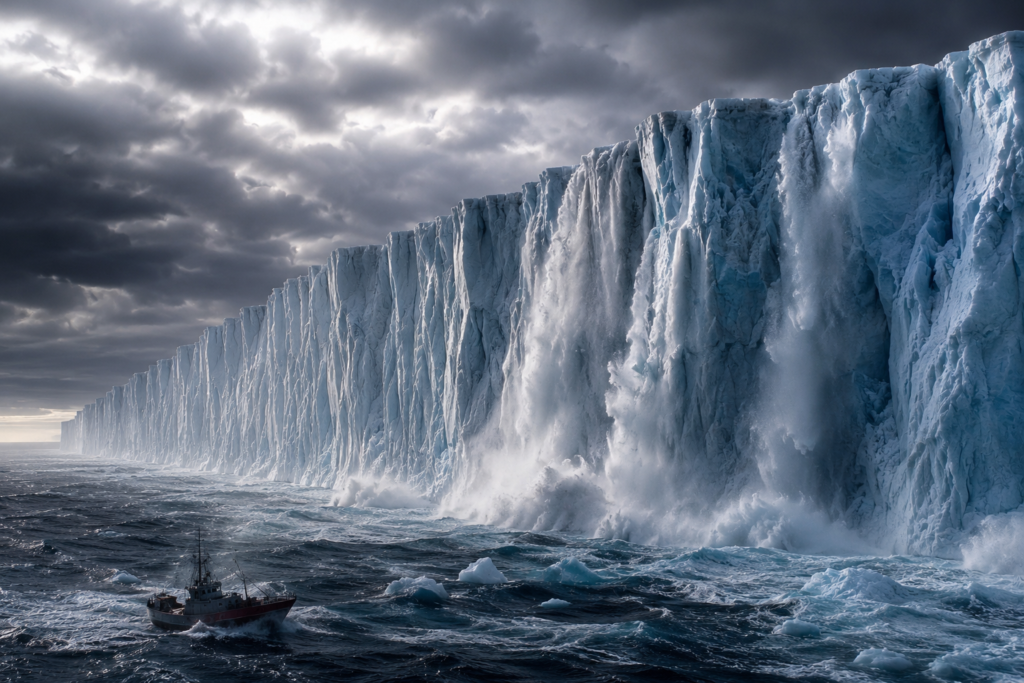
Dramatic images of Antarctic ice cliffs are frequently cited as supporting evidence for this theory.
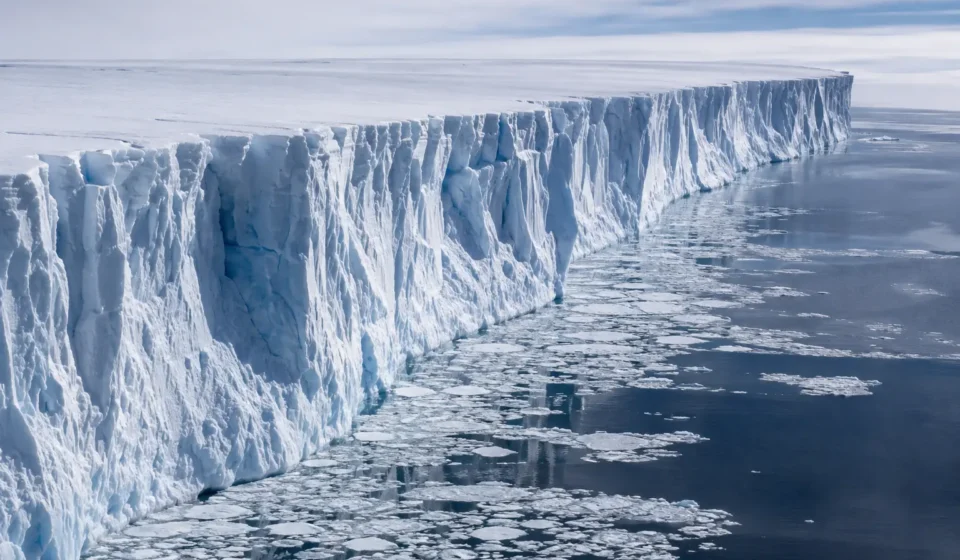
However, it is crucial to differentiate between actual Antarctic ice shelves or glacier faces and the proposed global “ice wall.” Antarctica does feature immense vertical ice fronts that can rise several meters above the ocean and extend over significant distances. Nevertheless, this does not confirm the existence of a continuous wall encircling the entire planet.
Antarctica Is a Genuine Continent
Antarctica ranks as the fifth-largest continent on our planet and is predominantly covered in ice. It encircles the geographic South Pole and houses the largest single ice mass on Earth.
Contrary to the popular notion of it being the “edge of the world,” Antarctica has been thoroughly researched by scientists from various nations.
Researchers engage in geological, atmospheric, oceanographic, astronomical, and biological investigations throughout the continent. Satellites consistently monitor Antarctica, while research stations function in diverse areas.
The continent is far from an unexplored void.
However, Antarctica continues to be one of the most challenging environments on Earth to investigate due to its harsh conditions.
Temperatures can plummet to extreme lows, fierce winds can arise, and vast sections of the continent are blanketed by ice several kilometers thick.
These factors inherently foster an air of enigma.
What Lies Beyond Antarctica?
A significant misconception regarding the term “beyond the ice wall” is the belief that Antarctica serves as an edge.
From a geographical standpoint, Antarctica is bordered by the Southern Ocean. Beyond this ocean lie parts of South America, Africa, Australia, and various island groups, depending on the direction of travel.
If one travels north from Antarctica, they will eventually cross the Southern Ocean and arrive at other landmasses.
There is no scientifically recognized continent beyond Antarctica’s coastline that forms a concealed ring around the globe.
Satellite imagery, navigation systems, geological studies, oceanographic research, and expeditions have all played a role in enhancing our comprehension of the area.
Why Do People Believe in a Hidden World?
The ice-wall theory gained significant traction as it often merges various concepts.
One such concept is the flat-Earth model. Another includes covert government operations in Antarctica. Some theories assert that governments are aware of undiscovered lands but restrict access to them for the general populace.
Other interpretations propose that ancient civilizations thrived beyond Antarctica or that vast areas remain concealed beneath the ice.
These theories are frequently illustrated through striking photographs, mysterious maps, videos, and anecdotal accounts.
The challenge lies in the fact that unusual evidence does not inherently validate an extraordinary assertion.
For instance, a photograph of a massive ice cliff confirms the existence of large ice cliffs but does not, on its own, prove that this cliff marks the edge of the entire Earth.
Antarctica and the Flat-Earth Theory
The contemporary ice-wall idea is closely linked to flat-Earth ideologies.
In numerous flat-Earth models, Antarctica is depicted as a vast circular ice barrier encircling the known world. The Sun and Moon are occasionally portrayed as relatively small entities moving above a flat surface.
This model contradicts a substantial amount of evidence from astronomy, physics, navigation, satellite technology, and direct observation.
For instance, different stars can be seen from various locations on Earth. The shadow of Earth during lunar eclipses is consistently curved. Ships vanish over the horizon in a way that aligns with Earth’s curvature, and global navigation systems function based on spherical Earth models.
Thus, the flat-Earth model necessitates alternative explanations for numerous independent observations.
The Antarctic Treaty and Its Enigma
One reason the narrative surrounding the ice wall garners interest is the Antarctic Treaty System.
Signed in 1959 and coming into effect in 1961, the Antarctic Treaty designates Antarctica primarily for peaceful purposes and scientific research.
It imposes limitations on military operations and sets forth guidelines for international collaboration.
Some online discussions interpret these limitations as proof that governments are concealing information.
Nevertheless, the presence of international regulations governing Antarctica does not inherently indicate the existence of hidden territories.
Antarctica presents a distinctive environment with significant environmental, logistical, and safety challenges. International governance is essential for overseeing scientific endeavors, tourism, environmental conservation, and territorial conflicts.
Can Regular Individuals Travel to Antarctica?
Indeed, individuals can travel to Antarctica, although the process is considerably more complex than visiting a standard tourist location.
Most tourism occurs through organized expeditions, especially around the Antarctic Peninsula. Travelers may utilize specialized cruise ships and, in certain instances, aircraft.
Tourism is subject to regulation due to Antarctica’s extremely delicate ecosystem.
Visitors are required to adhere to environmental and safety protocols, including measures aimed at minimizing wildlife disturbance and preventing pollution.
The regulated nature of access can sometimes lead to the misconception that Antarctica is entirely off-limits.
This is a misrepresentation.
While the continent is challenging and costly to access, it is not merely a restricted area that civilians cannot enter.
What About the Massive Ice Cliffs?
One of the most striking features of the ice-wall theory is the presence of vast ice cliffs.
Antarctic ice shelves can meet the ocean with dramatic vertical faces. Some of these cliffs are incredibly large and can stretch for several kilometers.
From sea level, the edge of an ice shelf can resemble a colossal frozen wall.
This phenomenon is real.
The error arises when a genuine geological feature is misinterpreted as proof of an entirely different geographical model.
The Earth is home to numerous breathtaking natural formations. A large glacier, canyon, mountain range, or ocean trench can seem enigmatic without serving as evidence of a concealed civilization or an undiscovered world.
What Might Be Concealed Under Antarctic Ice?
This is where the narrative becomes scientifically intriguing.
While there is no credible proof of secret continents beyond Antarctica, researchers have uncovered many captivating structures beneath the Antarctic ice.
Radar and other surveying technologies have unveiled mountains, valleys, lakes, and geological formations hidden beneath kilometers of ice.
Additionally, there are subglacial lakes located beneath the continent. These environments are significant because they offer scientists the chance to investigate ecosystems and geological processes that are isolated from the surface.
In essence, Antarctica indeed harbors a concealed world—but it is mainly a world beneath the ice, rather than a hidden continent beyond an ice wall.
Could There Be Unknown Life?
Scientists are particularly intrigued by the potential for microbial life in the extreme environments of Antarctica.
Microorganisms have the ability to endure conditions characterized by severe cold, scarce nutrients, and unique chemical environments.
As a result, subglacial environments hold significant importance for the field of astrobiology.
Researchers investigating Antarctic ecosystems can gain insights into how life persists under harsh conditions. These discoveries may also assist scientists in identifying potential habitats for life beyond Earth, such as beneath the icy crusts of Europa, one of Jupiter’s moons, or Enceladus, a moon of Saturn.
This represents one of the truly fascinating scientific enigmas linked to Antarctica.
Ancient Maps and Antarctica
Another widely discussed topic pertains to ancient maps that supposedly depict Antarctica prior to its ice coverage.
Certain historical maps have been viewed as evidence that ancient civilizations had advanced knowledge of the continent.
A frequently cited example is the Piri Reis map, which was created in the early 16th century.
Proponents of alternative theories often assert that sections of this map illustrate an ice-free Antarctica.
However, historians and cartographers have provided alternative interpretations of the map. Correlating old maps with contemporary geography can be challenging, as historical cartographers relied on incomplete data, distorted projections, and occasionally merged various sources.
Thus, an old map featuring a shape that resembles part of Antarctica does not automatically serve as proof of an ancient global expedition.
Why Antarctica Seems Like the Ideal Setting for a Mystery
Antarctica possesses nearly all the elements required for a contemporary mystery.
It is isolated.
It is vast.
It is challenging to access.
It experiences extreme weather conditions.
Large portions are covered in ice.
Much of its terrain is not visible directly from the ground.
Additionally, international treaties govern activities in the region.
These traits render Antarctica a perfect backdrop for narratives involving hidden civilizations, clandestine bases, uncharted territories, ancient technologies, and undiscovered realms.
Humans have always been intrigued by locations that are not easily reachable.
For centuries, unexplored seas and far-off continents have sparked similar myths.
In the present day, Antarctica occupies a significant part of that psychological landscape.
The Distinction Between Mystery and Evidence
It is entirely reasonable to pose questions about Antarctica.
Curiosity is fundamental to science itself.
The crucial inquiry is what transpires after the question is posed.
A true scientific inquiry seeks evidence that can be tested independently.
If someone asserts that an undiscovered continent lies beyond Antarctica, researchers would anticipate measurable evidence such as satellite images, geological data, independent expedition findings, or other verifiable observations.
A viral video or an unexplained image may prompt further investigation, but it does not constitute adequate proof on its own.
This differentiation is vital when engaging in discussions about contentious topics online.
Are There Still Unknown Aspects?
Certainly.
Scientists do not assert that every aspect of Antarctica is fully comprehended.
New findings are consistently emerging.
Researchers continue to explore the continent’s geology, climate history, subglacial environments, ecosystems, ice dynamics, and its connection to global climate systems.
There may be geological formations that remain unmapped. There may be microorganisms yet to be discovered.
Undoubtedly, there are numerous regions of Antarctica that have been rarely visited by humans.
However, stating “we don’t know everything” does not imply that “anything is possible.”
Scientific uncertainty operates within a framework of evidence.
The True Frontier Is More Captivating Than the Myth
Interestingly, the authentic Antarctica may be more intriguing than the imagined ice-wall realm.
Envision a landscape where massive mountains lie hidden beneath kilometers of ice.
Picture lakes existing in total darkness beneath the continent.
Visualize ancient climate data preserved within ice cores.
Consider microorganisms thriving in conditions that resemble those scientists might find elsewhere in the Solar System.
These represent genuine scientific frontiers.
They do not necessitate a concealed continent.
They do not require a hidden civilization.
They simply demand ongoing exploration.
Why Social Media Sustains the Theory
Social media has revolutionized the dissemination of enigmatic topics.
A brief video showcasing a massive ice cliff in Antarctica can garner millions of views when paired with a captivating question like:
“What lies beyond the ice wall?”
This question is compelling as it sparks curiosity without offering an immediate answer.
Additionally, algorithms often favor content that elicits strong emotional responses.
Once an individual views one video about the ice wall, they may start receiving suggestions for similar content. Before long, the viewer could come across hundreds of assertions that seem to corroborate each other.
This can create the illusion that a theory is backed by substantial evidence, even when many videos merely reiterate the same initial claim.
A Thoughtful Approach to Investigating the Question
There is nothing inherently wrong with delving into unconventional ideas.
In fact, challenging widely accepted explanations can sometimes lead to authentic discoveries.
However, a constructive method is to categorize information into three groups:
Documented: Backed by trustworthy observations, measurements, or established research.
Uncertain: A field where scientists are still exploring and evidence remains incomplete.
Speculative: A concept that currently lacks adequate evidence.
The theory regarding the Antarctic ice wall primarily falls into the speculative category.
Nevertheless, Antarctica itself harbors numerous legitimate scientific uncertainties and enigmas that are still worthy of investigation.
Conclusion
The concept of “Beyond the Ice Wall” stands as one of the most intriguing modern enigmas on the internet. It merges the harsh conditions of Antarctica with ancient cartography, theories of secret governments, flat-Earth beliefs, uncharted territories, and humanity’s innate curiosity to uncover what exists beyond our known realm.
However, there is no credible scientific proof of a massive ice wall encircling the Earth with concealed continents beyond it.
What truly exists is much more concrete: a sprawling frozen continent, vast ice shelves, mountains hidden beneath kilometers of ice, subglacial lakes, unique ecosystems, and an environment that continually poses challenges to scientists.
Perhaps the most significant takeaway from Antarctica is that reality does not require embellishment to be enigmatic.
There remain areas on Earth that are challenging to explore and inquiries that scientists cannot fully resolve. The genuine adventure lies not in uncovering a hidden world beyond a fictitious boundary.
It is in the exploration of the remarkable world that already exists.
While the notion of a mystery beyond the ice wall persists, Antarctica itself continues to be one of the planet’s most significant frontiers.